What are flock cameras and drones?
Flock Cameras
They look like little more than a solar panel bolted to a pole. But the boxes going up on street corners, at intersections, and along quiet neighborhood roads across the country are something far more invasive: automated surveillance devices, built by a company called Flock Safety, that photograph and permanently log every single vehicle that passes underneath them.
Every camera runs around the clock, whether or not there's any reason to be suspicious of the cars going by. Each pass is logged with a plate number, make, model, color, and distinguishing details like roof racks, bumper stickers, and body damage. It is then timestamped and tied to a location, then fed into a searchable database that police departments across the country can query. There is no version of this where the system only watches people suspected of a crime. It watches everyone, all the time, and sorts out later who might be "interesting."
That data doesn't stay local, either. Once a police department signs on with Flock, it's cameras join a much larger network, and other agencies, sometimes dozens, sometimes thousands, and not infrequently agencies in other states entirely can be granted the ability to search it. Most people whose movements are being logged this way have no idea their own city's cameras are quietly feeding a nationwide surveillance web, and there's no mechanism for a resident to opt out, request their data back, or find out who has looked them up and why.
You are being watched every time you drive past one of these cameras. Not because you did something wrong, not because anyone suspects you of anything, but simply because you exist, and you drove down the wrong street. That should unsettle you.
For more on how these systems actually operate, see the Electronic Frontier Foundation's reporting on Flock's surveillance technology and the ACLU of Rhode Island's breakdown of Flock cameras in this state.
.jpg/:/cr=t:20.93%25,l:25.41%25,w:49.17%25,h:58.14%25/rs=w:400,h:300.7518796992481,cg:true,m)
Flock Drones: Surveillance Takes Flight
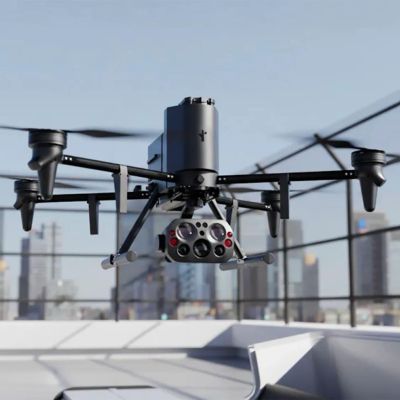
Flock Safety didn't stop at fixed cameras bolted to poles. In October 2024, the company acquired Aerodome, a "Drone as First Responder" company, and folded its automated drone fleet directly into the same surveillance platform that runs its license plate cameras. The pitch to police departments is speed: a single click launches a drone from a weatherized rooftop dock, and it flies itself to the scene of an alert with no pilot required on-site, and often faster than an officer can arrive by car.
But the drones aren't just cameras in the sky watching a single incident. According to Flock's own product materials, these drones are directly wired into the same alert system as the ground cameras and can be triggered automatically by a license plate hit, a gunshot detection sensor, or an alarm, and dispatched without a human ever making the initial call to send one. And as the EFF has reported, Flock's own aviation executives have described these drones as, in effect, flying license plate readers meaning every flight is an opportunity to log the plate, and the identity, of every vehicle in view, not just the one the drone was sent to find.
Flock has continued expanding what these drones can do without a human steering them. Recent updates to the company's Aerodome platform include "Inflight LPR," which turns every drone camera into a license plate reader capable of checking plates against police hotlists mid-flight, and "Vehicle Follow," which lets a drone autonomously trail a moving car, matching its speed, predicting its path around obstacles, and keeping it in frame with a single click and no pilot actively flying it.
Put together, this is not simply a faster way to respond to 911 calls. It's a second layer of always-armable, self-directing aerial surveillance stacked on top of the fixed camera network already watching every street, one that can be launched automatically, follow a vehicle on its own, and add yet another stream of plate data to the same databases already shared across state lines. The sky above your neighborhood is no longer necessarily just sky.

A citizenry that is aware of always being watched quickly becomes a compliant and fearful one.
Bob Barr, former U.S. Congressman